Entity-First SEO: How Google Actually Understands Your Site
Older SEO advice treated a page as a bag of keywords to hit a target density for. Google has moved well past that: it identifies entities — people, places, organizations, concepts — and understands a page’s relevance partly through which related terms and entities co-occur around it, not just which exact phrase was matched.
What this means in practice
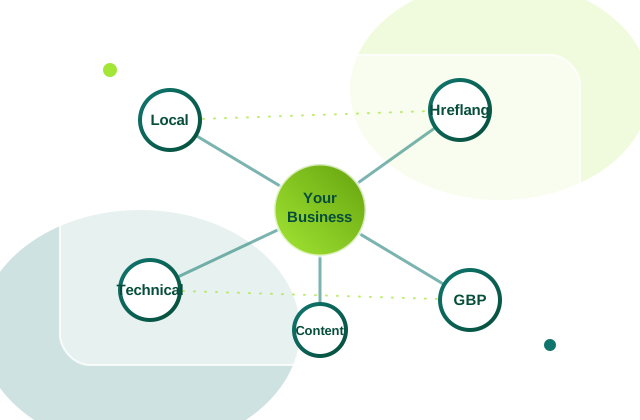
A single well-written page about “SEO services” signals less topical authority on its own than that same page sitting inside a cluster of genuinely related, cross-linked content — local SEO, technical audits, hreflang, Google Business Profile — because the cluster is what builds out the entity relationships Google is looking for.
This is also why thin, disconnected blog posts do little for authority even when they are technically “content”: a single unrelated post does not create the phrase co-occurrence a real cluster does.
Building a cluster that actually works
A working cluster has one pillar page (broad, commercial: your core service page), several supporting articles that each go deep on one related sub-topic, and consistent internal linking between all of them in both directions — pillar to article and article back to pillar, plus article to article where genuinely relevant.
This article is itself part of that structure: it links back to our SEO services in Dubai pillar page and out to local SEO, technical SEO and hreflang — the supporting cluster that page needed.